Desire to Again Glory for Country Led to Europeans Exploratiobn
Amerigo Vespucci: Italian explorer who named America
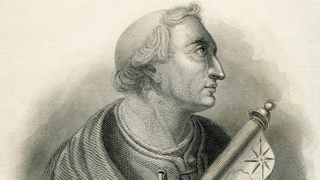
Italian explorer Amerigo Vespucci is all-time known for his namesake: the continents of Due north and Due south America. But why were these continents named after him, particularly since his voyages happened after Christopher Columbus arrived on the continent, in 1492?
Vespucci was the first person to recognize Northward and Due south America as singled-out continents that were previously unknown to Europeans, Asians and Africans, according to Avihu Zakai ("Exile and Kingdom: History and Apocalypse in the Puritan Migration to America", Cambridge University Printing, 2002). Prior to Vespucci's discovery, explorers, including Columbus, had causeless that the New World was office of Asia. Vespucci made his discovery while sailing almost the tip of South America in 1501, according to The New World Encyclopaedia.
Amerigo Vespucci was one of many European explorers during the Age of Exploration, or Age of Discovery, which took place from the mid-1400s to mid-1500s. "The Age of Exploration was prompted past different motivations," said Erika Cosme, authoritative coordinator of education and digital services at The Mariner'southward Museum and Park in Virginia. "In the 15th century, Europe, Asia, and Africa were at the epicenter of a global exchange of goods; also, for Europeans, curiosities of different cultures connected to emerge. This Afro-Eurasian economy created an interwoven connection between Bharat, China, the Heart East, Africa and Europe."
Spurred past curiosity and economic incentive, explorers traveled distances that were keen feats for their twenty-four hours. But what makes the fourth dimension flow so important, said Cosme, was the role information technology played in "shaping the world that we know today." Recognizing the Americas was a major part of that understanding.
Early life
Amerigo Vespucci was born on March ix, 1454, in Florence. Equally a swain, he was fascinated with books and maps, according to the Mariners Museum. The Vespuccis were a prominent family unit and friends with the powerful Medicis, a family who ruled Italia for more than 300 years and were prominent during the Renaissance. After beingness educated by his uncle, Vespucci himself worked for the Medicis as a banker and afterwards supervisor of their send-outfitting business concern, which operated in Seville, Spain. He moved to Spain in 1492, co-ordinate to Biography.com
This business allowed Vespucci to meet the bang-up explorers' ships existence prepared and to learn well-nigh the business of exploration. Goods like salt from Mali, coffee beans from Federal democratic republic of ethiopia, spices from Republic of india and the Molucca Islands and ginger, silk and tea from People's republic of china were in high need, said Cosme, who works in developing The Mariners' Museum'south all-encompassing Age of Exploration area.
Countries profited off trade and hoped to observe riches like gold, silver and gems, Cosme explained . "European leaders saw exploration as a way to expand their empires and increase national glory."
At the fourth dimension, explorers were searching for a northwest route to the Indies — the lands and islands of Southeast Asia — which would make trade easier and bring their country wealth, according to Britannica. "Information technology would often take years to complete a trip," said Cosme. "By the mid-15th century, Muslims controlled the majority of the trade routes to Asia. This meant they could charge high prices for incoming and outgoing goods and vessels traveling to and from Europe and Asia. The want to find ocean routes that were faster, safer, and cheaper stimulated a search to observe a better way of getting to these places."
Vespucci's business helped outfit one of Columbus's voyages, and in 1496 Vespucci had the opportunity to talk with the explorer. Both men were fascinated by the works of Marco Polo, who influenced many explorers' love of seafaring and exploration, said Cosme.
This meeting further encouraged Vespucci's interest in travel and discovery. Similar many explorers of the age, he wanted to gain new knowledge and see the world with his ain eyes. "The Age of Exploration coincided with the Renaissance, which lasted from about 1300 to 1600," said Cosme. "Many people were gaining 18-carat marvel virtually the world. Sciences like astronomy and cartography were surging. People wanted to know more than about the geography, people, and cultures outside their own."
Vespucci's business was struggling, which made his decision to voyage even simpler. Furthermore, he possessed critical knowledge for seafaring, like cartography and astronomy, which were essential tools for early navigation, said Cosme. Now in his 40s, Vespucci decided to leave business organisation behind and commence on a journey while he however could.
First voyage and alphabetic character controversy
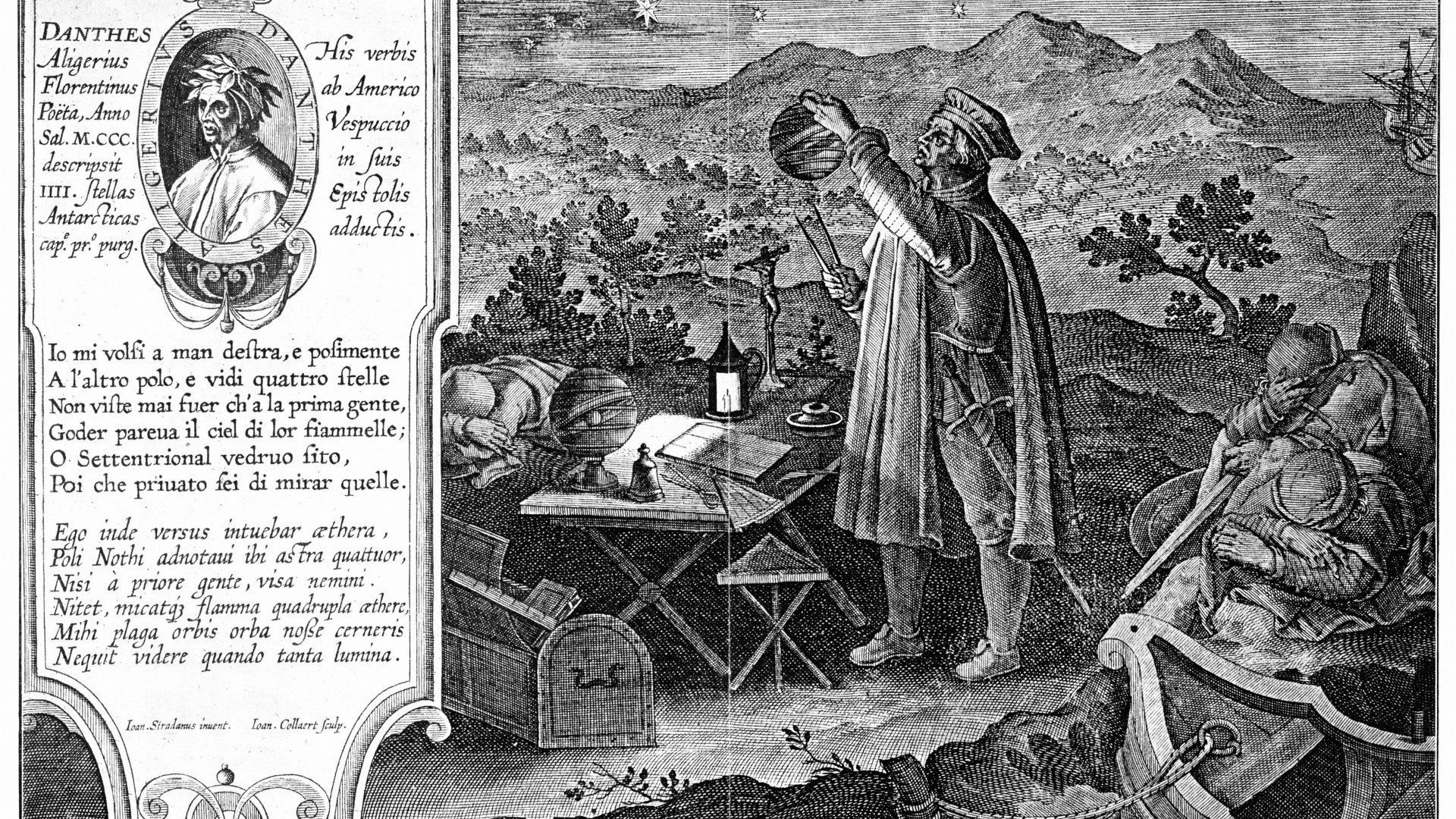
"Amerigo Vespucci took at least iii voyages westward," said Cosme. There is some controversy among historians about when Vespucci ready sail on his offset voyage. Many accounts place the sail engagement in 1499, seven years after Columbus landed in the Commonwealth of the bahamas. On the 1499 voyage, Vespucci sailed to the northern part of Southward America and into the Amazon River. He gave places he saw names like the "Gulf of Ganges," thinking, every bit his explorer contemporaries did, that he was in Asia. He also made improvements to celestial navigation techniques. Vespucci predicted World's circumference accurately within 50 miles, co-ordinate to Springer.
Merely a letter dated in 1497 suggests that the 1499 voyage may have in fact been Vespucci's second trip, according to Fordham University. The letter is written in Vespucci'southward voice, though some historians dispute his authorship and the facts of the document, challenge it a forgery. The letter, written to the Gonfalonier of Florence (a loftier official on the city-land's supreme executive council), accounts a 1497 trek to the Bahamas and Central America. If the accounts of this letter are truthful, then Vespucci reached the mainland of the Americas a few months earlier John Cabot and more than than a year earlier Columbus.
1501 voyage and recognition of South America
On May xiv, 1501, Vespucci gear up sail to the New World under the Portuguese flag on what would be his most successful voyage, according to Edward Shaw ("Discoverers and Explorers ," Weitsuechtig, 1900.)
Vespucci's ships traveled along the S American coast down to Patagonia, co-ordinate to The New World Encyclopaedia. Along the way, he encountered the rivers Rio de Janeiro and Rio de la Plata. During this voyage, Vespucci came to suspect that he was looking at a continent entirely dissimilar from Asia.
"Vespucci was both familiar with and fascinated by the accounts of Marco Polo and his fourth dimension in Asia. The book by Polo gave great detail on the geography, people, and rich opportunities of the continent. Based on this data, Vespucci could brand assumptions about the land they were exploring," Cosme said.
"For starters, Vespucci noticed that the heaven which they sailed nether had different constellations that were not visible in Europe," Cosme said. "He also took notation of the coastlines they traveled, recording their distance and length of time traveled. Vespucci, again a very skilled cartographer and astronomer, advisedly studied and pondered over all of his information.
"He found that the areas and country masses they had explored were actually larger and dissimilar than previous accounts of Asia's descriptions. This led him to the conclusion that what they had explored was indeed an entirely new continent."
He verified his suspicion when sailing s to within 400 miles of Tierra del Fuego, the southernmost tip of South America, co-ordinate to an article by Wired. This confirmed that he was encountering a new continent that extended far further southward than anyone had guessed.
While on this voyage, Vespucci wrote letters to a friend in Europe describing his travels and identifying the New World as a separate continent from Asia. These messages as well relate his encounters with the indigenous people and depict their civilization. Vespucci described the natives' religious practices and beliefs, their nutrition, union habits, and, most appealingly to readers, their sexual and childbirth practices. These letters were published in several languages and sold well (meliorate than Columbus' letters, co-ordinate to Stanford Academy) across Europe. This pleased Vespucci who, who recorded his adventures to better leave "some fame backside me after I die."
Later voyages and other accomplishments
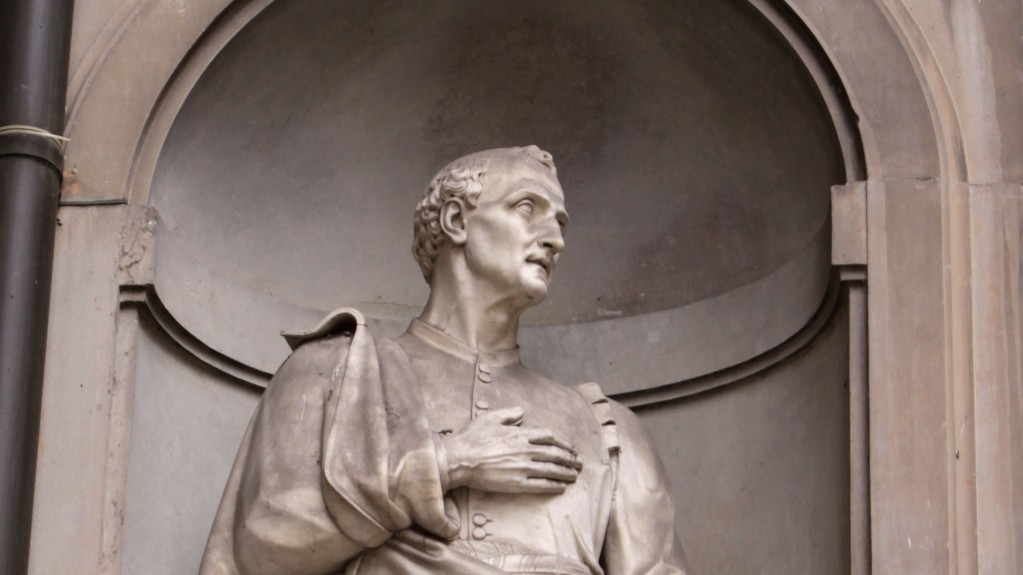
Vespucci's later voyages were not as successful as the 1501 trek, and , according to Britannica, scholars are unsure of exactly how many later voyages he embarked upon. In 1503, he sailed to Brazil, just when his fleet failed to brand any new discoveries, the ships disbanded. Vespucci pressed on, still, and discovered the island of Bahia and South Georgia before returning to Lisbon ahead of schedule ("The First 4 Voyages of Amerigo Vespucci ," Forgotten Books, 2017) .
Vespucci may take gone on two more voyages, in 1505 and 1507, only accounts are unclear. In 1505, he became a naturalized citizen of Spain, and in 1508, he was named a Pilot Major of Espana, according to Frederick J Pohl ("Amerigo Vespucci", Columbia University Press, 1944). This was a prestigious position that required him to use his considerable navigational skills. Vespucci helped develop and standardize navigational techniques and to select new pilots.
He worked at this post until his decease on Feb. 22, 1512. He contracted malaria and died in Spain at almost 58 years of historic period. Vespucci is buried in Florence.
The naming of America
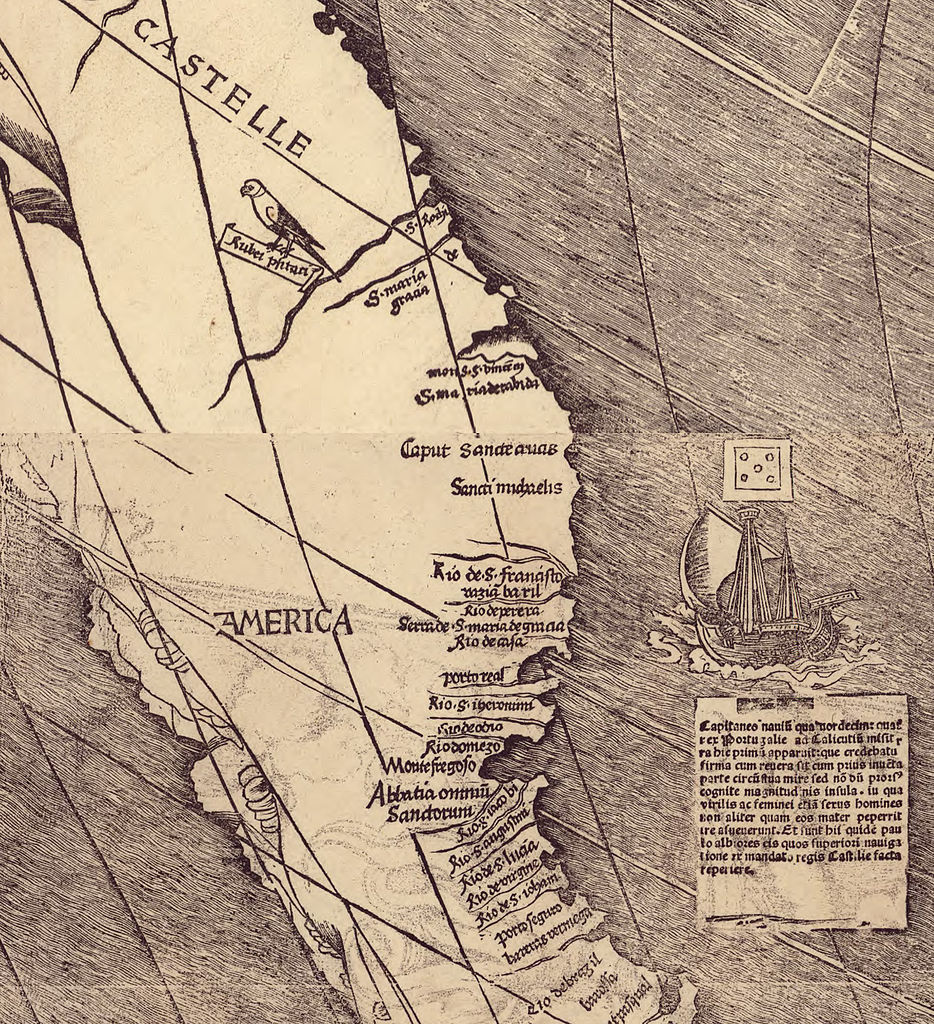
Vespucci's reputation has gone through periods of ridicule, and at times he has been viewed every bit a schemer who attempted to steal celebrity from Columbus, co-ordinate to History.Info. But in reality, it wasn't Vespucci's appetite that got ii continents named after him: information technology was the work of a German language clergyman and amateur cartographer called Martin Waldseemüller.
In 1507, Waldseemüller and another scholars were working on an introduction to cosmology that would contain large maps, according to the U.S. Library of Congress. Waldseemüller proposed that a portion of Brazil that Vespucci had explored exist named "America," a feminized version of Vespucci'southward first name. Waldseemüller wrote, "I see no reason why anyone should justly object to calling this role ... America, later on Amerigo [Vespucci], its discoverer, a man of bang-up power."
The name stuck. Waldseemüller'south maps sold thousands of copies across Europe. Some reports advise, for case the Library of Congress, that Waldseemüller had second thoughts about the name America, but information technology was too late. In 1538, a mapmaker named Gerardus Mercator applied the name "America" to both the northern and southern landmasses of the New Earth, co-ordinate to Yale Academy and the continents have been known as such ever since.
Regardless, there is no underestimating the value of Vespucci'south contributions to Europeans. Cosme said, "Amerigo Vespucci used his own cognition and skill, plus the written noesis from scholars and explorers earlier him to uncover a Mundus Novus (Latin for "new world") to Europeans."
Additional resource
To acquire more virtually the Waldseemüller map from which America would get its proper name, cheque out this article from the Library of Congress. To learn more nigh Vespucci himself, read this piece from The Ma r iners' Museum. Or effort this article from PBS World Explorers.
Bibliography
- Avihu Zakai ("Exile and Kingdom: History and Apocalypse in the Puritan Migration to America", Cambridge University Press, 2002)
- Amerigo Vespucci, The New Globe Encyclopaedia
- Amerigo Vespucci, Ages of Exploration: Mariners Museum
- Amerigo Vespucci, Biography.com
- The Sea Route West to Cathay, Brittanica.com
- Edward Shaw ("Discoverers and Explorers", Weitsuechtig,1900.)
- Randy Alfred, "The Homo is a Continent…Or Two" Wired, March 9th 2020
- Amerigo Vespucci, "The Commencement Four Voyages of Amerigo Vespucci",Forgotten Books, 2017
- Frederick J Pohl ("Amerigo Vespucci", Columbia University Press, 1944)
- "1512: Amerigo Vespucci- The Man Who Stole The Glory From Christopher Columbus", History.Info
- John R Herbert, "The Map That Named America", Library of Congress
- "Mapamundi of 1538", Yale University
- Gyula Pápay, "Amerigo Vespucci's Contribution to the Modernization of Cartographic Representation" Springer (17th Century, 2020)
Source: https://www.livescience.com/42510-amerigo-vespucci.html
0 Response to "Desire to Again Glory for Country Led to Europeans Exploratiobn"
Post a Comment